
Second Shift.
The American auto industry left behind thousands of acres of graded, powered, rail-served land. The buildout of the AI era needs exactly that.
Industrial Redevelopment · 6 min read
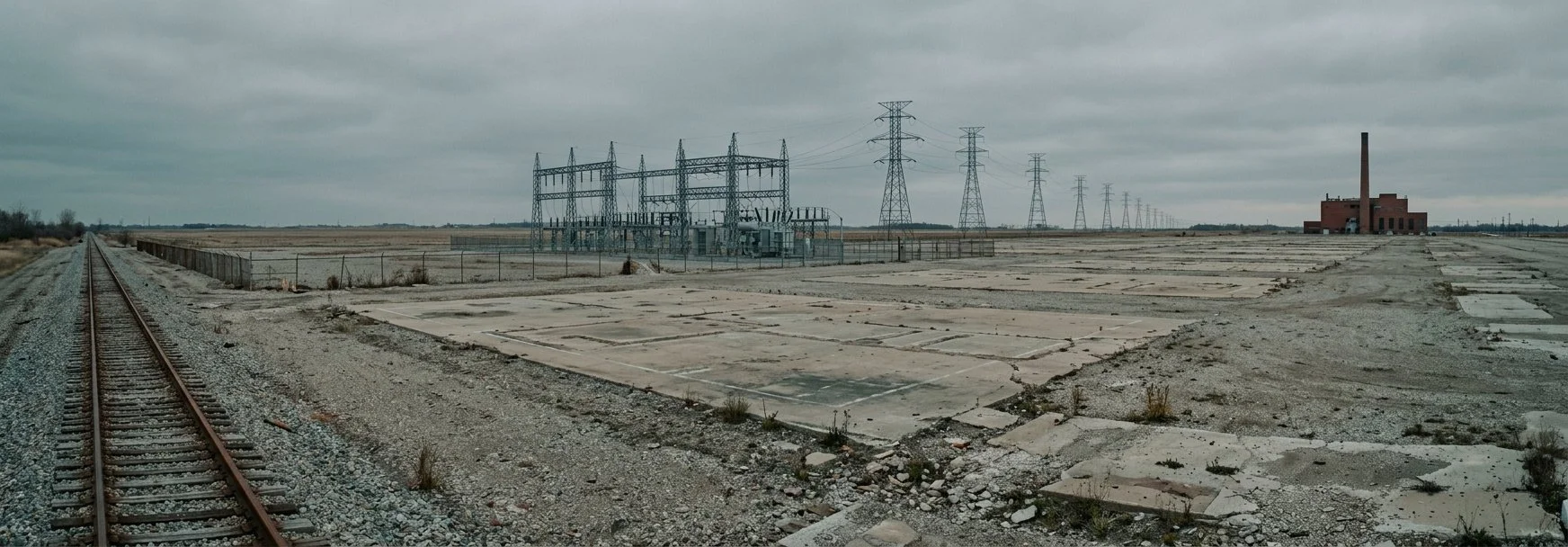
Not a Tridun Property. Image is for illustration only
Buick City is where General Motors built cars for generations, and where the plant sat demolished and idle long after. In late 2023 the trust that inherited it completed the sale of the last 273 acres to Ashley Capital, an industrial developer now building the Flint Commerce Center: about ten buildings, roughly 3.5 million square feet, an expected $300 million of investment, and an estimated 2,500 permanent jobs.(1)
Getting there took a coalition: the City of Flint, Genesee County, the State of Michigan, the Charles Stewart Mott Foundation, and the Flint and Genesee Economic Alliance. An hour west, in Lansing, three former GM plant sites totaling more than 200 acres are moving through cleanup toward the same kind of second life, with the state committing about $19 million to prepare one of them(2).
Neither project is a data center. That is the useful part. They show the machinery of revival already working in Michigan. The question worth asking is what these places are worth to whoever needs land next.
Where this land came from
When General Motors collapsed into bankruptcy in 2009, it left behind more than a balance sheet. Scattered across fourteen states sat the physical remains of a century of American manufacturing: assembly plants, foundries, stamping and powertrain facilities. Many were already silent. Some were contaminated. Nearly all were too complicated for an ordinary buyer to touch.
Out of that, in March 2011, a federal bankruptcy court created something unusual. The Revitalizing Auto Communities Environmental Response Trust, known as RACER, was given one job: clean these places up and find them a new use. At its formation it held more than 80 locations, roughly 6,800 acres and 167 buildings, which made it one of the largest holders of industrial land in the country(3).
Fifteen years on, the trust reports 98 completed sales covering more than 5,000 of those acres(4). The interesting question is no longer what GM left behind. It is what the remaining ground, and the hundreds of similar sites in other hands, can carry.
The hard part is already done
The defining feature of a former auto plant is that the expensive, slow work happened decades ago. The land was graded and cleared. Heavy power was run to it, because an assembly line demanded it. Rail often reaches the property line. Water infrastructure is in place. And the site sits inside a community that understands industrial work in its bones.
That list is close to a specification sheet for the most demanding new use in the economy. Data centers used about 4.4 percent of all U.S. electricity in 2023, and the Department of Energy's national laboratory projects that share reaching somewhere between 6.7 and 12 percent by 2028(5). Power, not land or fiber, has become the constraint that decides where computing gets built.
The grid connection an assembly plant once needed is the grid connection a computing facility needs now.
Consider Massena, New York, at the top of the state where the St. Lawrence River forms the border with Canada. RACER holds 209 acres there with half a mile of shoreline, CSX rail on the property, a substation a fifth of a mile away, and one of the largest hydroelectric complexes in the Northeast next door. When the trust put the parcel out for offers, it addressed the call specifically to experienced data center developers and operators, citing the low-cost hydropower(6). The market has already read the specification sheet the same way.
There is a quieter argument underneath the obvious one. Putting this infrastructure on land that has already been used, rather than carving it out of untouched ground, does two things at once. It brings dormant acreage back into production, and it spares somewhere else.
Cleanup comes first
None of it happens before the land is made safe, and that sequence is written into how the trust was built. Legacy auto sites frequently carry decades of contamination. RACER's founding mandate puts remediation ahead of sale: comprehensive assessment, cleanup under long-term monitoring, and regulatory closure before a parcel is cleared for its next life. Fifty-eight formerly contaminated parcels have reached closure so far(4). For the communities involved, that order of operations is the whole point. A fenced-off parcel that has sat idle for twenty years contributes nothing. No tax base, no jobs, no use, and a liability that only gets older. Restoring it removes the liability and replaces it with something productive in the same motion.
Why the scarcity is the opportunity
Follow the arithmetic. New computing capacity needs large blocks of firm power, and getting a new grid connection can take years; the national laboratory that tracks interconnection queues has documented waits stretching past half a decade for projects seeking to connect(7). Meanwhile, communities are pushing back hard on greenfield campuses: a group that tracks local opposition counted $64 billion of U.S. data center projects blocked or delayed between May 2024 and March 2025, and more than $150 billion in 2025 alone(8). A site that already has heavy interconnection, rail, regulatory closure, and a town that wants industry back is therefore rare, slow to create from scratch, and getting more valuable every year the queue grows. Scarcity of that kind is where durable returns come from, whether the end use is a single large campus or a cluster of smaller, locally owned computing units spread across a region. The land does not care which; it is ready for both.
What the places get back
An economic analysis prepared for RACER by Industrial Economics, Incorporated, covering the trust's first fourteen years through April 2025, attributes 72,630 jobs and $25.8 billion in annual economic output to activity at its properties(4). Numbers at that scale invite squinting, and they should be read as what they are, an estimate of a portfolio's ripple effects. But even discounted heavily, they point at something real. These are regions that powered the last industrial era and were too often written off as casualties of the next one. Bringing a long-dormant plant back into use restores a tax base, pulls investment toward existing infrastructure instead of away from it, and gives a skilled local workforce something to build again.
The land the old economy used up may turn out to be exactly what the new one needs.
Sources
RACER Trust and Ashley Capital complete sale of Buick City property; $300 million investment expected, an estimated 2,500 jobs. RACER Trust news release, November 2023. https://www.racertrust.org/news/racer-trust-ashley-capital-complete-sale-buick-city-property-300-million-investment-expected-result-estimated-2500-jobs
Michigan to spend $19M on last piece to redevelop ex-GM plant in Lansing (Plant 6); RACER property listings for Lansing Plant 3 (105 acres) and Plant 2 (Lansing Township). Bridge Michigan, updated May 15, 2025; RACER Trust property pages, 2025. https://bridgemi.com/business-watch/michigan-spend-19m-last-piece-redevelop-ex-gm-plant-lansing/
Who we are and what we do (portfolio at formation: 14 states, 6,776 acres, 167 buildings). RACER Trust, accessed September 2026. https://www.racertrust.org/who-we-are-and-what-we-do
RACER Trust a catalyst for more than 72,000 jobs, $25.8 billion in annual economic output (Industrial Economics, Inc. analysis, March 2011 to April 2025; 98 sales; 58 parcels at regulatory closure). RACER Trust news release, August 19, 2025. https://www.racertrust.org/news/racer-trust-catalyst-more-72000-jobs-258-billion-annual-economic-output
2024 United States Data Center Energy Usage Report. Lawrence Berkeley National Laboratory for the U.S. Department of Energy, December 20, 2024. https://eta-publications.lbl.gov/sites/default/files/2024-12/lbnl-2024-united-states-data-center-energy-usage-report_1.pdf
Massena Powertrain Plant property page and call for offers addressed to data center development and operating firms. RACER Trust, accessed September 2026. https://www.racertrust.org/news/racer-trust-soliciting-offers-purchase-and-development-industrial-property-massena-ny
Queued Up: Characteristics of Power Plants Seeking Transmission Interconnection, 2025 edition. Lawrence Berkeley National Laboratory, 2025. https://emp.lbl.gov/queues
Data center opposition report ($64 billion blocked or delayed, May 2024 to March 2025) and Q3 to Q4 2025 update (more than $150 billion in 2025). Data Center Watch, 2025. https://www.datacenterwatch.org/report