
Through the Cable.
A data center is coming to the county. The only question that really matters is whether any of it will belong to the people who live there.
Community Infrastructure · 6 min read
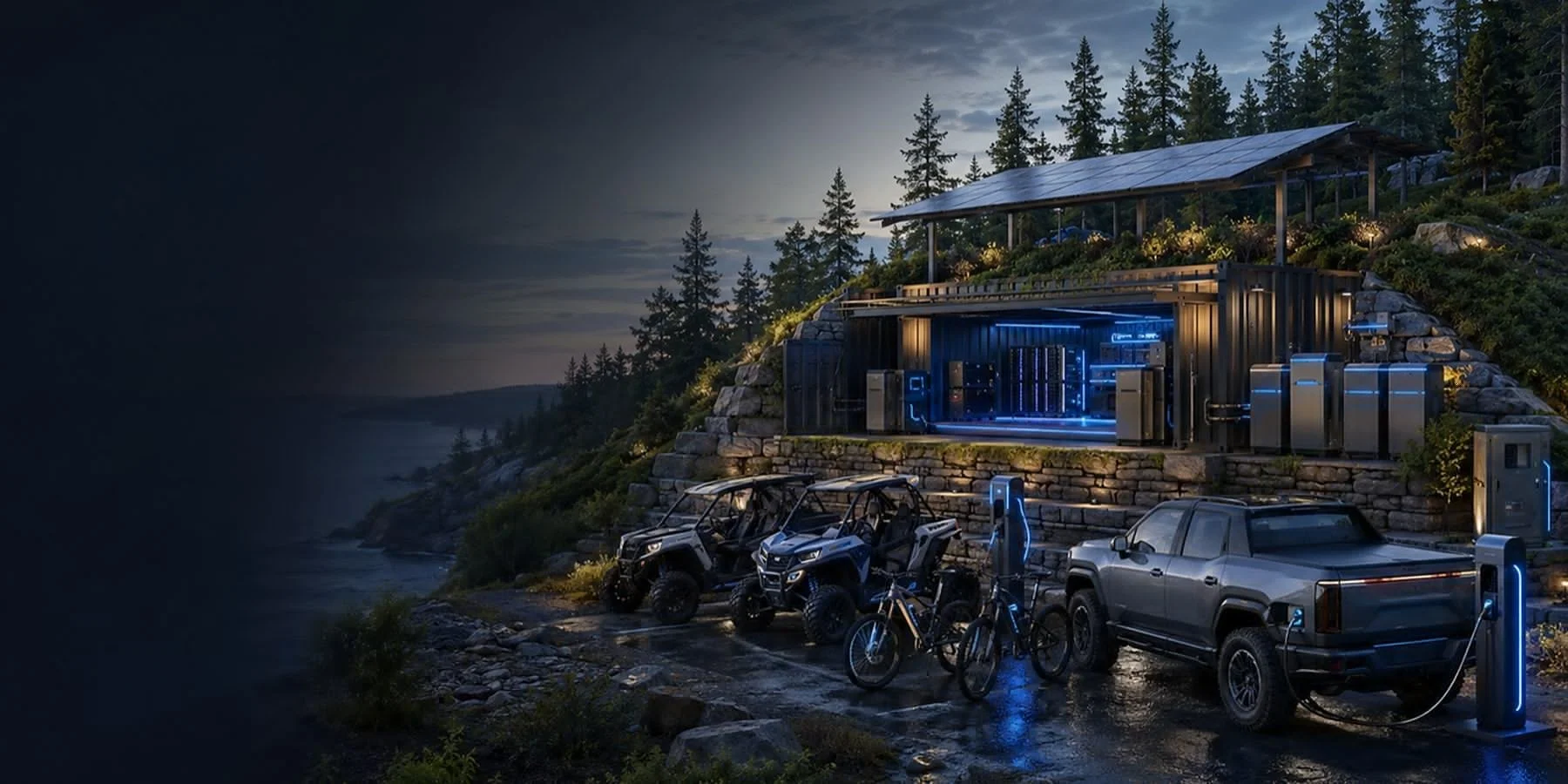
Not a Tridun Property. Image is for illustration only
It has happened enough times now to have a shape.
The screens go first. Somebody in billing notices a file will not open, and then no file will open. By nine the clinic is on paper. At the utility the outage map is frozen on last night's picture, so a lineman drives out to look at the substation with his own eyes, because that is the only way left to know anything. The people who could fix this are three states away behind a ticket number. The records everyone needs are in a cloud that is not answering.
This is not a hypothetical. In May 2024 a ransomware attack on a fifteen-state hospital system sent its Michigan hospitals back to paper charts, diverted ambulances, and delayed imaging and prescriptions(1). In July 2026 a coordinated attack hit the control systems of more than thirty municipal water utilities in Minnesota; weeks later nine Michigan water systems were probed the same way(2). The Environmental Protection Agency has found that more than seventy percent of the water systems it inspected were out of compliance with basic requirements, some with critical cybersecurity gaps as simple as unchanged default passwords(3).
It ends eventually. It almost always costs more than the ransom: in a 2025 survey of 3,400 organizations, the average cost of recovering from an attack, before any ransom, was $1.53 million(4).
Now set that morning beside a second fact. A developer wants a few hundred acres two exits up the highway. Heavy grid connection, water strategy, fiber, permits, a tax package. Within a year there will be more computing power inside the county line than the county has ever had.
None of it will be theirs.
The bargain, looked at honestly
Say yes and the town gets a construction boom, a modest number of permanent jobs, and a line on the tax roll. That is not nothing. In a lot of places it is a great deal better than nothing, and nobody should be sneered at for taking it.
But follow the value. The land is local. The power is local. The water, the road work, the approvals, and every ounce of political capital spent getting them are local. The ownership is somewhere else. The customers are somewhere else.
The machines will hum away on the edge of town, and what they produce will leave through a strand of glass, and on the next bad Tuesday the clinic will still be on paper.
Communities have noticed. A group that tracks local opposition counted $64 billion of U.S. data center projects blocked or delayed between May 2024 and March 2025, and more than $150 billion in 2025 alone, most of it over power bills, water, and noise(5).
Turn it around
Picture the same county with something different behind the fence at the municipal utility.
A single unit, container-sized. A solar canopy over it, a battery cabinet beside it. Nothing about it announces itself. It is smaller than the water tower and quieter than the substation.
It is designed so that on the morning the screens go dark, an administrator can cut it off from the public internet and keep running. The outage map stays live. Charts open at the clinic. Payroll goes out. The utility's own AI tools keep answering questions about its own assets, on its own hardware, behind its own door. The design target is as much as ten days of that on stored power, and it is a target rather than a proven field number today, but the direction is the whole point.
Continuity is what a hospital is actually buying. Everything else is a feature.
And the town owns it.
Ownership is the entire argument
Not the county board running a server floor. That misunderstanding kills the idea in the first meeting. A locally controlled entity holds the asset. Professionals build it, secure it, run it, and sell its capacity under agreements with teeth. Outside capital is welcome and is compensated for the risk it takes. What outside capital does not get is the steering wheel, and that has to be written down and locked before anyone breaks ground.
There is precedent. Roughly 750 community-owned broadband networks now operate in the United States, run by cities, electric cooperatives, and public utilities that decided the last generation of digital infrastructure should not be something that merely happened to them(6). Compute is the next layer, and the same logic applies.
Everything after that is arithmetic. Revenue covers operations, security, insurance, debt, reserves, and the operator. What is left is shared between the people who put capital in and a portion the community directs at whatever it decides it needs: training, housing, broadband, grid work. That is the financial return, and it is real. The civic return is larger and harder to price. A town that owns its compute gets a say in how artificial intelligence arrives in its schools, its clinic, its utility, and its city hall, instead of finding out how it arrived.
One big campus, or a hundred small ones
The reason this is possible at all is a change in scale.
The picture everyone carries is a campus you can see from an airplane. That model concentrates the capital, the politics, the permitting, and the waiting, all of it stacked into a single project that must clear every hurdle before anything exists.
Lococompute goes the other way. Many small nodes instead of one enormous site. Standardized, containerized, sized for a rural hospital, a school district, a municipal utility, a Tribal enterprise, a county government. A customer starts with what it can actually use and grows as the work proves out. Nobody waits a decade for a groundbreaking.
The large cloud providers see the same demand for control and now sell "sovereign cloud" regions with legal and technical separation from their main networks(7). For a national government, that may be enough. For a rural utility or a Tribal nation, a region operated by someone else, somewhere else, is still someone else's cloud. Small enough to buy. Close enough to matter.
Built by people you can call
The plan is to build the units at the Powder Mill in Marquette. Fabrication, wiring, cooling, batteries and solar, security, software, testing, then out the door and into the field, with service running back to the same building.
That is not a logistics footnote. There is a difference between a region that takes delivery of its infrastructure and a region that builds, tests, and repairs it. The second one keeps its electricians, its fiber techs, its cybersecurity people. Skilled hands stay where the work is.
What sovereignty actually means
For Tribal nations, this stops being an argument about uptime.
The National Congress of American Indians has affirmed that Tribes hold an inherent sovereign right to govern the collection, ownership, and use of data about their peoples, lands, and resources(8). Health records, enterprise systems, government files, language and cultural material: a local node means those live inside a perimeter the nation itself controls, under its own rules, on its own ground. Not promised in a vendor contract that can be renegotiated or breached. Structurally true.
Every other customer arrives at the same place by a different road. Almost nobody left has data they can comfortably hand to somebody else's cloud.
What is at stake
Do this badly and you get a fenced industrial box that a town resents for thirty years. So put the nodes on ground that has already been used up rather than clearing new. Cool them in closed loops that do not drain the aquifer. Build them out of timber and regional stone, berm them, buffer the noise, keep the light off the night sky. Secure without feeling hostile. Industrial without feeling extractive.
Do it well and something rarer happens. The infrastructure of this era stops being something that shows up and starts being something a place decided to build.
Data centers are coming to communities. Those with the awareness to ask the right questions will own the answers and the gains.
Sources
Cyber attack forces Michigan hospitals to use paperwork (Ascension ransomware incident). GovTech, from The Detroit News, May 21, 2024. https://www.govtech.com/security/cyber-attack-forces-michigan-hospitals-to-use-paperwork
30-plus Minnesota municipal water systems targeted in coordinated cyberattack (MPR News, July 28, 2026); Cyberattacks target nine Michigan water systems, Lansing BWL sees uptick in attempts (WILX, August 3, 2026). MPR News; WILX, 2026. https://www.mprnews.org/story/2026/07/28/30-minnesota-municipal-water-systems-targeted-cyberattack
EPA outlines enforcement measures to help prevent cybersecurity attacks and protect the nation's drinking water. U.S. Environmental Protection Agency, May 20, 2024. https://www.epa.gov/newsreleases/epa-outlines-enforcement-measures-help-prevent-cybersecurity-attacks-and-protect
The State of Ransomware 2025 (survey of 3,400 IT and security leaders; mean recovery cost $1.53 million excluding ransom). Sophos, June 24, 2025. https://www.sophos.com/en-us/blog/the-state-of-ransomware-2025
Data center opposition report ($64 billion, May 2024 to March 2025) and Q3 to Q4 2025 update (more than $150 billion in 2025). Data Center Watch, 2025. https://www.datacenterwatch.org/report
Community Network Map: roughly 750 community-owned broadband networks. Institute for Local Self-Reliance, 2024. https://communitynets.org/content/community-network-map
Announcing initial services available in the AWS European Sovereign Cloud. Amazon Web Services, 2025. https://aws.amazon.com/blogs/security/announcing-initial-services-available-in-the-aws-european-sovereign-cloud-backed-by-the-full-power-of-aws/
Resolution in support of U.S. Indigenous data sovereignty. National Congress of American Indians, June 2018. https://archive.ncai.org/resources/resolutions/support-of-us-indigenous-data-sovereignty-and-inclusion-of-tribes-in-the-development-of-tribal-data