
Firm Power.
The Upper Peninsula learned the hard way what it costs to depend on power made somewhere else. The forest, the sun, and a battery cabinet offer a different answer.
Energy · 6 min read
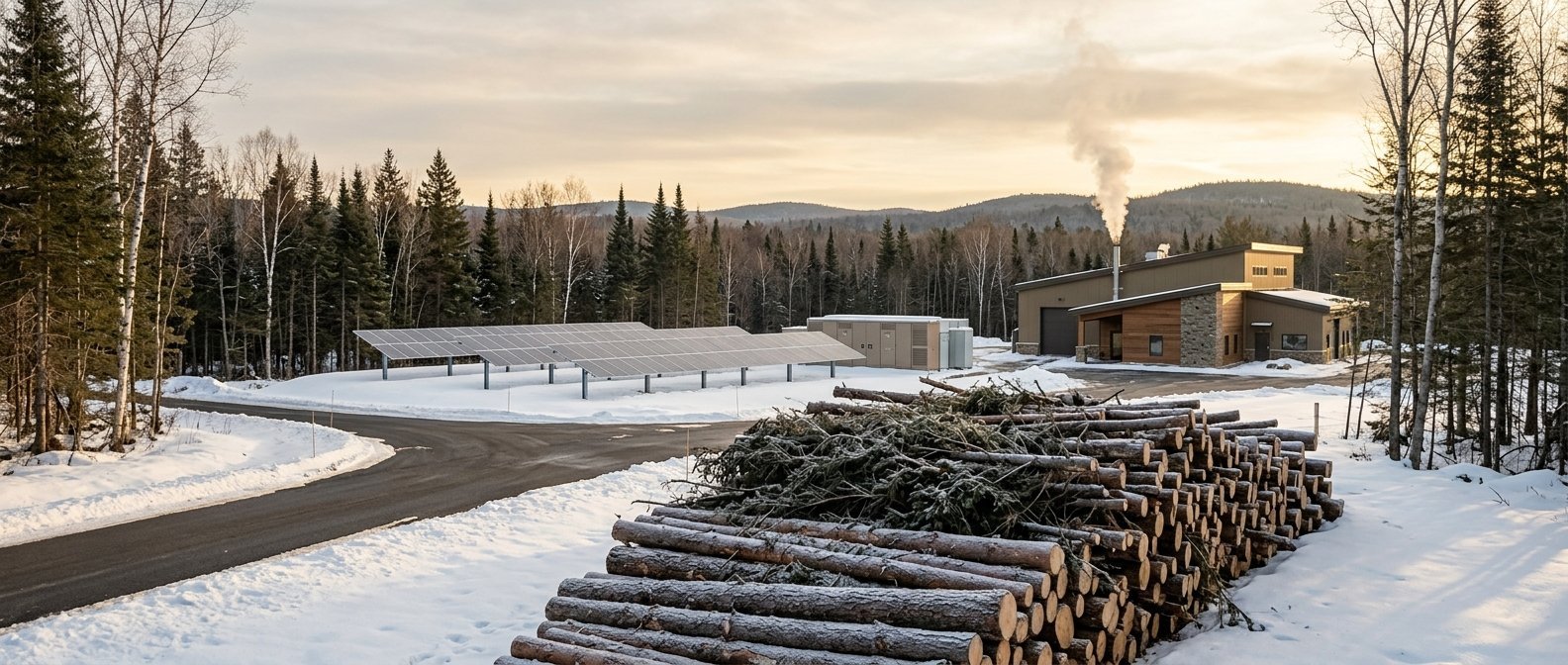
Not a Tridun Property. Image is for illustration only
The Upper Peninsula is tied to the rest of the grid by a single high-voltage link installed in 2014, and its transfer capacity is limited(1). Electrically, the UP is closer to Wisconsin than to Detroit. That one fact explains most of the region's energy history for the past decade.
In 2019 the Presque Isle Power Plant in Marquette, 450 megawatts of coal built in the 1970s, shut down for good(2). In the years leading up to it, the cost of keeping the plant running for grid reliability was pushed onto UP customers, and rates rose roughly twenty percent(1). Residential customers of the region's largest utility were paying 20 to 25 cents per kilowatt-hour, about forty percent above the average for Michigan's investor-owned utilities(3).
The replacement was instructive. Rather than build hundreds of millions of dollars of new transmission to import power, the region built 188 megawatts of fast-starting reciprocating engine plants in Negaunee and Baraga, avoiding an estimated $373 million in grid upgrades(1). The lesson was not about gas. It was that generation close to the load, sized to the load, beat a bigger wire.
The next version of that lesson is being written now, and it does not have to burn anything imported.
Firm means it runs in February
Solar and wind are cheap and getting cheaper, but they are weather. In 2024, utility-scale solar in the United States ran at an average of 23 percent of its rated capacity and wind at 34 percent. Plants burning wood and other biomass ran at 56 percent, because their fuel is on hand whenever it is needed(4). The federal Energy Information Administration puts it plainly: biomass and geothermal have the highest capacity factors among renewables because their energy sources are relatively constant(5).
The UP has the fuel. Logging leaves tops and limbs at every landing, and Michigan State University forestry researchers estimate tens of millions of cubic feet of that residue are generated in the UP each year, with most of it available after leaving a quarter on the forest floor for soil health(6). The state's own harvesting guidance calls for retaining a sixth to a third of residues, more on poor soils, along with standing dead trees and streamside buffers(7). Done that way, the fuel supply renews itself and the forest is better for it.
Combined heat and power turns that residue into two products at once: electricity, and useful heat that a conventional power plant would throw away. Across Lake Michigan, Menominee Tribal Enterprises has run a biomass combined heat and power plant at its sawmill in Neopit, Wisconsin, since 2016, fueled by its own wood waste, co-funded by the Department of Energy, and projected to save the enterprise about $405,000 a year in operating costs(8).
Generation close to the load, sized to the load, beat a bigger wire. The next version does not have to burn anything imported.
The battery is the hinge
Firm generation is half the answer. The other half is the ability to keep running when the wire goes down.
In 2016 the Blue Lake Rancheria in northern California built a microgrid around a 500 kilowatt solar array and roughly 950 kilowatt-hours of battery storage, serving its government offices, casino, hotel, and event center(9). When California's utility cut power across the region in 2019 to reduce wildfire risk, the Rancheria's campus stayed lit and became a refuge for the surrounding community(10). An islanded microgrid is not a laboratory idea; it has kept the lights on when everything around it went dark.
Put biomass, solar, and storage together behind one point of control and a Tribal utility or a small municipal utility owns something rare: dispatchable power it can run on its own terms, with a stored reserve for the day the tie line fails.
Who owns the plant
Ownership is where the economics turn. A utility that owns its generation keeps the margin that would otherwise leave the region as a wholesale power bill, and it gains a say over its own rates that the last decade denied it.
The financing tools for that kind of ownership already exist, and they favor exactly these owners. The Department of Energy's Tribal Energy Loan Guarantee Program can guarantee up to $2 billion in loans for Tribal energy projects, covering up to ninety percent of unpaid principal and interest(11). The Department of Agriculture's Rural Utilities Service has financed rural cooperative and public-power infrastructure since the Rural Electrification Act of 1936, and it has backed Tribal utilities at scale, including $235 million for the Navajo Tribal Utility Authority(12). Every one of these programs has eligibility rules, and none of them is a given. But the door is open to owners who look like Upper Peninsula utilities and Tribes.
Give the power somewhere to go
A generator needs a customer that runs around the clock. Here is where local energy and local compute become one story instead of two. A containerized computing unit at the utility draws a steady load, day and night, winter and summer. It is the anchor customer that makes a small plant pencil, and it pays for firm power because continuity is the whole reason it exists.
The heat closes the loop. Computers make heat; a February in the UP needs it. In Espoo, Finland, waste heat from a new data center is being routed into the district heating system to warm up to 100,000 homes(13). A single container will not heat a town, but it can heat a greenhouse, a school, a maintenance shop, or the wood-drying kiln next to the plant that feeds it.
What is actually at stake
Michigan has committed to 80 percent clean energy by 2035 and 100 percent by 2040(14). The UP can meet that by importing more power over a wire it does not control, or by building generation it owns from fuel it already has, matched to loads that keep skilled work in the region.
One of those paths repeats the last decade. The other one ends it.
Power you own, from fuel you already have, feeding work that stays home. That is what firm means above the bridge.
Sources
2024 Upper Peninsula Energy Report (single HVDC interconnection installed 2014; SSR rate impact; UMERC plants of 131.6 MW at Negaunee and 56.4 MW at Baraga, online March 2019, avoiding an estimated $373 million in transmission upgrades). Michigan Public Service Commission, 2024. https://www.michigan.gov/mpsc/-/media/Project/Websites/mpsc/regulatory/reports/2024_Upper_Peninsula_Energy_Report_with_Appendices.pdf
Presque Isle Power Plant (450 MW, retired March 2019). Global Energy Monitor, accessed September 2026. https://www.gem.wiki/Presque_Isle_Power_Plant
Demystifying sky-high electricity rates in Michigan's Upper Peninsula. Bridge Michigan, August 2019. https://bridgemi.com/michigan-environment-watch/qa-demystifying-sky-high-electricity-rates-michigans-upper-peninsula/
Electric Power Annual, Table 4.8.B, capacity factors for utility-scale generators (2024: wood and biomass 55.8 percent, wind 34.3 percent, solar 23.2 percent). U.S. Energy Information Administration, 2025. https://www.eia.gov/electricity/annual/html/epa_04_08_b.html
Frequently asked questions: capacity factors of renewable generators. U.S. Energy Information Administration, accessed September 2026. https://www.eia.gov/tools/faqs/faq.php?id=104&t=3
Michigan Woody Biomass Supply Snapshot (Western and Eastern UP logging residue estimates after 25 percent retention). Michigan State University Department of Forestry, undated; verify vintage before quoting figures. https://pages.mtu.edu/~jamyles/static_test/michiganforestbiofuels.org/sites/default/files/michigan-woody-biomass-supply-snapshot_0.pdf
Michigan Woody Biomass Harvesting Guidance (IC4069). Michigan Department of Natural Resources, May 10, 2010. https://mimlc.com/PDF/Woody-Biomass-Harvesting-Guidance.pdf
Menominee Tribal Enterprises biomass combined heat and power plant, Neopit, Wisconsin. U.S. Department of Energy, Office of Indian Energy, 2016. https://www.energy.gov/node/1712691
Blue Lake Rancheria kicks off solar system construction (500 kW solar, 950 kWh storage microgrid). U.S. Department of Energy, Office of Indian Energy, 2016; article updated August 2019. https://www.energy.gov/indianenergy/articles/blue-lake-rancheria-kicks-solar-system-construction
Amid shut-off woes, a beacon of energy (Blue Lake Rancheria during 2019 public safety power shutoffs). The Washington Post, January 1, 2020. https://www.washingtonpost.com/climate-solutions/2020/01/01/amid-shut-off-woes-beacon-energy/
Tribal Energy Loan Guarantee Program (up to $2 billion in guarantees; up to 90 percent of unpaid principal and interest). U.S. Department of Energy, accessed September 2026. https://energycommunities.gov/funding-opportunity/tribal-energy-loan-guarantee-program/
Electric Programs (Rural Utilities Service); USDA invests $235 million in the Navajo Tribal Utility Authority. U.S. Department of Agriculture, Rural Development, accessed September 2026. https://www.rd.usda.gov/programs-services/electric-programs
Nordic homes are being warmed by waste heat from massive data centers (Espoo, Finland, up to 100,000 homes). Bloomberg, republished by Environmental Health News, June 5, 2025. https://www.ehn.org/nordic-homes-are-being-warmed-by-waste-heat-from-massive-data-centers
Clean Energy Standard under Public Act 235 of 2023 (80 percent clean energy by 2035, 100 percent by 2040). Michigan Public Service Commission, accessed September 2026. https://www.michigan.gov/mpsc/commission/workgroups/2023-energy-legislation/clean-energy-standard