
Above the Bridge.
Michigan's Upper Peninsula has quietly assembled what advanced manufacturing actually asks for: engineers, power, and a culture built on tolerances.
Advanced Manufacturing · 6 min read
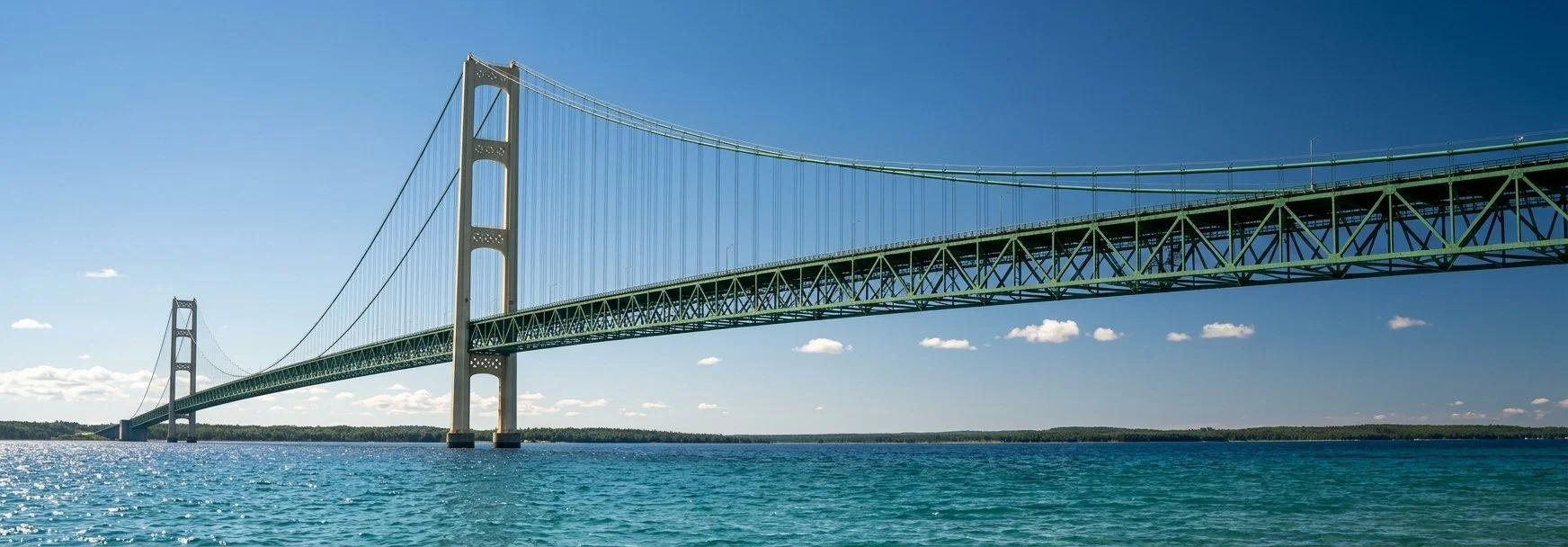
Image is for illustration only
"Going above the bridge" is a phrase that conveys more attitude than direction. It is rooted in showing up early, before the weather cooperates; finishing the work without complaint; banding together to reach the goal; and taking humble pride in doing it right. In the UP, that is not the exception. It is the standard.
For a century and a half the UP sent iron and copper down to the mills and factories that built the American century. Iron mining on the Marquette Range and copper mining on the Keweenaw both began in the 1840s and 1850s(1). It has always been a place that makes the things other places depend on.
That history is worth holding onto right now, because the country is in the middle of rebuilding a capability it let drift overseas.
Almost every American industry of consequence runs on advanced semiconductors, and defense runs on them hardest of all. Yet roughly two thirds of the world's advanced chipmaking capacity sits in Taiwan(2). The response has been an expensive national scramble to bring production home. Capital has not been the constraint; TSMC alone has committed $165 billion to its Arizona campus(3). Neither has political will. The constraint has been finding places that can actually carry the work.
Not every part of that work belongs in a desert megaproject. A leading-edge fab is a project measured in tens of billions of dollars. But the supply chain around it, advanced packaging, test and assembly, specialty and mature-node production, and the defense microelectronics that depend on them, is being sited in smaller American communities on purpose. Federal CHIPS awards finalized in December 2024 included an advanced packaging plant in Covington, Georgia, and a materials facility in Colorado Springs(4). That tier of manufacturing needs engineers and technicians in volume, and it needs them nearby. It needs reliable power. It needs dense connectivity and, increasingly, serious computing capacity of its own. And it needs something harder to procure: a regional culture that takes precision seriously. The Upper Peninsula has an unusually strong claim on all four.
The talent is already there
Start with the part most regions cannot fake. Houghton is home to Michigan Technological University, which in February 2025 earned Carnegie R1 classification, the designation reserved for the nation's leading research institutions and one held by only four universities in Michigan(5). Michigan Tech runs a dedicated robotics engineering program and in 2025 earned an endorsement from the ARM Institute, the national institute for advanced robotics in manufacturing(6). About 100 miles east by road, in Marquette, Northern Michigan University adds ABET-accredited mechanical and electrical engineering technology programs, the hands-on, applications-focused training that production floors actually run on(7). One school pushes the frontier. The other staffs the line. Between them, a region of roughly 300,000 people produces engineering talent far out of proportion to its size(8).
What makes it more than a statistic is that the UP has organized itself around that talent rather than simply exporting it. Through Northern Michigan University and the Innovate Marquette SmartZone, the region runs Invent@NMU, a student-powered incubator founded in 2014 that puts undergraduates into real product development close to where they trained(9). That is the mark of a place paying attention. A manufacturer that lands here does not just inherit graduates. It inherits an ecosystem already pointed in the right direction, and a habit of keeping young engineers home.
Why the compute belongs next to the plant
There is a strategic reason advanced manufacturing and AI infrastructure ought to sit in the same region instead of two different ones.
Modern manufacturing depends on heavy computation, and where that computation happens matters. Running it locally rather than over a distant cloud keeps sensitive design and process data close, secure, and fast. A region with its own compute can support work that a cloud-dependent region cannot host as easily or as safely. The infrastructure and the factory reinforce each other, which is why efforts in Marquette to treat advanced compute as something closer to a utility service are not a side project. They are groundwork.
That connection extends to how a plant would actually be run. The federal CHIPS program has funded a $285 million national institute, SMART USA, to build shared digital twins for semiconductor manufacturing: live virtual models of production processes that let a facility optimize faster and learn from standardized industry data instead of starting from scratch(10). A new plant that can plug into that kind of infrastructure shortens the distance between a first shift and a good yield.
The whole game is tolerances
Semiconductor manufacturing is won or lost on margins most industries never have to think about. Cleanrooms are held to air-quality standards where a handful of particles in a cubic meter matter, and yield turns on variations far smaller than the width of a human hair. That discipline has to run all the way down, from the cleanroom design to the wrench in someone's hand.
Regions do not acquire that mindset by announcing it. They either have it in the way people already work, or they spend a decade learning it. Ask anyone who has kept a mine hoist, a paper machine, or a Lake Superior ore dock running through a February. Precision under difficult conditions is not a new idea above the bridge.
The demand does not stop at chips
The same plants and the same workforce line up with other fast-growing sources of national demand. The Department of Defense's fiscal 2027 budget request seeks roughly $75 billion for drones and counter-drone systems, its largest such investment on record, and every one of those systems is built from sensors, processors, and precision components(11). A region built to semiconductor tolerances is well positioned to serve that demand as it grows, whichever administration is writing the budget.
What is actually at stake
The hard, valuable move is bringing the advanced-manufacturing tier of the semiconductor and defense supply chain to Michigan's Upper Peninsula: packaging, test, specialty production, precision components, and the compute that supports them. The region can carry it, because it produces the engineers and has organized itself around them. Local compute makes sensitive production viable here in a way it is not everywhere. And the demand reaches well past chips.
The prize is not only jobs, though it is jobs, and good ones. It is not only keeping graduates in the state that trained them, though that matters more every year. It is a region that owns a capability the rest of the country is scrambling to rebuild, at a scale a region of 300,000 can actually build, staff, and keep.
Above the bridge, it is not a departure from the past but a reflection of what has always been in the UP: a work ethic with the skills and tolerances that now govern world industry.
Sources
Copper mining timeline, Keweenaw National Historical Park. National Park Service, accessed September 2026. https://www.nps.gov/kewe/learn/historyculture/copper-mining-timeline-page-2.htm
Foundry capacity market share of advanced processes (Taiwan about 66 percent in 2024). TrendForce, May 14, 2024. https://www.trendforce.com/news/2024/05/14/insights-trendforce-foundry-capacity-market-share-of-advanced-process-to-decline-in-taiwan-korea-until-2027-while-us-on-the-rise/
TSMC intends to expand its investment in the United States to $165 billion. TSMC news release, March 4, 2025. https://pr.tsmc.com/english/news/3210
CHIPS incentives awards to Absolics (Covington, Georgia, advanced packaging) and Entegris (Colorado Springs). U.S. Department of Commerce, NIST, December 5, 2024. https://www.nist.gov/news-events/news/2024/12/biden-harris-administration-announces-chips-incentives-awards-absolics-and
Michigan Tech awarded R1 classification reserved for the nation's leading research institutions. Michigan Technological University, February 13, 2025. https://www.mtu.edu/news/2025/02/michigan-tech-awarded-r1-classification-reserved-for-nations-leading-research-institutions.html
Michigan Technological University earns ARM Institute endorsement. Michigan Technological University, 2025. https://www.mtu.edu/news/press/releases/2025/michigan-technological-university-earns-arm-endorsement.html
Engineering Technology programs (ABET accredited). Northern Michigan University, accessed September 2026. https://nmu.edu/engineeringtechnology/programs
Upper Peninsula population, 303,123 (2023 estimate). U.S. Census Bureau, via Federal Reserve Bank of Minneapolis regional snapshot, May 2024. https://www.minneapolisfed.org/-/media/assets/events/2025/2025-regional-economic-conditions-conference/berglund_mi.pdf
About Invent@NMU. Invent@NMU, accessed September 2026. https://invent.nmu.edu/about-us/
SMART USA Institute selected as the CHIPS Manufacturing USA Institute for Digital Twins ($285 million). Semiconductor Research Corporation via Business Wire; NIST, November 19, 2024. https://www.nist.gov/news-events/news/2024/05/chips-america-announces-285-million-funding-opportunity-digital-twin-and-0
Pentagon plans largest-ever investment in drones and counter-drone weapons (fiscal 2027 request). DefenseScoop, April 21, 2026. https://defensescoop.com/2026/04/21/dod-plans-largest-ever-investment-drones-anti-drone-weapons/